Historical Landmarks in Park Slope
Park Slope, a historic neighborhood in Brooklyn, New York, is renowned for its beautiful brownstone buildings, tree-lined streets, and rich cultural heritage. Among its many historical landmarks, three stand out for their architectural significance, historical importance, and contribution to the community: The Old Stone House, Grand Army Plaza, and Prospect Park. These landmarks not only reflect the neighborhood’s development but also serve as reminders of its historical and cultural evolution.
Image from Wikimedia.org
The Old Stone House
The Old Stone House is a reconstructed Dutch colonial farmhouse located in Washington Park, between Fourth and Fifth Avenues. Its historical significance dates back to the American Revolutionary War, particularly the Battle of Brooklyn in 1776. Originally built in 1699 by Dutch settlers, the house was strategically positioned near Gowanus Creek and served as the Vechte-Cortelyou House. It played a crucial role during the Battle of Brooklyn, where American troops, including the Maryland 400, made a valiant stand against British forces, allowing General George Washington’s army to retreat and ultimately regroup.
The original structure was destroyed in the early 19th century, but a reconstruction of the house was built in the 1930s using some of the original materials. Today, the Old Stone House serves as a museum and community center, dedicated to preserving and interpreting the history of the Revolutionary War and the early Dutch settlers in Brooklyn. The museum features exhibits, educational programs, and events that highlight the house’s historical significance and its role in American history.
Architecturally, the Old Stone House is a fine example of Dutch colonial style, with its thick stone walls, gabled roof, and large central chimney. The reconstruction aimed to maintain the authenticity of the original structure, providing visitors with a glimpse into the 17th-century colonial life. The house’s historical and educational value makes it a cherished landmark in Park Slope, connecting the community to its colonial roots and Revolutionary War heritage.
Grand Army Plaza
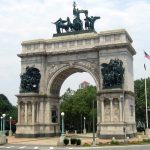
Grand Army Plaza, located at the northern entrance of Prospect Park, is one of Brooklyn’s most iconic landmarks. Designed by Frederick Law Olmsted and Calvert Vaux, the plaza was completed in 1867 as a grand entrance to Prospect Park, which they also designed. The centerpiece of Grand Army Plaza is the Soldiers’ and Sailors’ Arch, dedicated in 1892 to honor the Union Army and Navy troops who served in the Civil War. The arch is an architectural marvel, adorned with sculptures by renowned artists such as Frederick MacMonnies and Thomas Eakins. The Soldiers’ and Sailors’ Arch stands as a symbol of victory and remembrance, with its grand bronze sculptures depicting scenes of Civil War battles and allegorical figures representing the triumph of the Union. The arch is surrounded by other notable monuments, including the Bailey Fountain, the John F. Kennedy Memorial, and statues of historical figures like Abraham Lincoln and Alexander J.C. Skene. These elements together create a space that honors the past while serving as a central gathering point for the community.
Grand Army Plaza is also a significant urban planning achievement. Its design incorporates a large traffic circle that connects several major thoroughfares, including Flatbush Avenue, Eastern Parkway, and Prospect Park West. The plaza’s landscaped gardens, fountains, and wide-open spaces provide a serene and welcoming environment amidst the bustling city. It serves as a gateway to Prospect Park, inviting visitors to explore the natural beauty and recreational opportunities the park offers.
Prospect Park
Prospect Park, a sprawling urban oasis adjacent to Park Slope, is a masterpiece of landscape architecture. Designed by Frederick Law Olmsted and Calvert Vaux, the park opened in 1867 and covers 526 acres of diverse natural and recreational areas. The park’s design reflects the vision of its creators, who aimed to provide a serene escape from urban life, similar to their earlier work on Central Park in Manhattan. One of the most notable features of Prospect Park is the Long Meadow, a vast open field that stretches over a mile and provides space for picnics, sports, and leisure activities. The park also includes the Ravine, a wooded area with winding trails, waterfalls, and a stream that creates a tranquil natural environment. The Prospect Park Boathouse, built in 1905, is another architectural gem within the park. The boathouse, designed in the Beaux-Arts style, is situated on the Lull water and serves as a visitor center and event space.
The park is also home to the Prospect Park Zoo, the Prospect Park Bandshell, and the LeFrak Center at Lakeside, which offers ice skating, roller skating, and other seasonal activities. The diversity of recreational facilities and natural landscapes makes Prospect Park a beloved destination for residents and visitors alike.
Conclusion
Together, these landmarks highlight the historical depth and architectural beauty of Park Slope, making it a neighborhood that celebrates its past while thriving in the present.