







Slip and fall accidents in Sheepshead Bay often involve hazards that disappear before the injured person can prove what happened — a spill gets mopped, ice gets salted, a broken step gets patched. In New York, a premises liability claim requires showing that the property owner or operator failed to keep the area reasonably safe and that they knew or should have known about the dangerous condition. A Sheepshead Bay slip and fall lawyer can help preserve time-sensitive evidence and identify the responsible parties before critical proof is lost.
How Slip and Fall Accidents Happen in Sheepshead Bay
Sheepshead Bay’s mix of apartment buildings, small businesses, restaurants along Emmons Avenue, retail strips on Sheepshead Bay Road, and busy sidewalks near transit access points creates a range of premises liability hazards. Different property owners, management companies, commercial tenants, and maintenance contractors may each be responsible for the same walkway, vestibule, stairwell, or parking area — and sorting out who controlled the hazard is often the central challenge in a fall case.
Indoor Falls
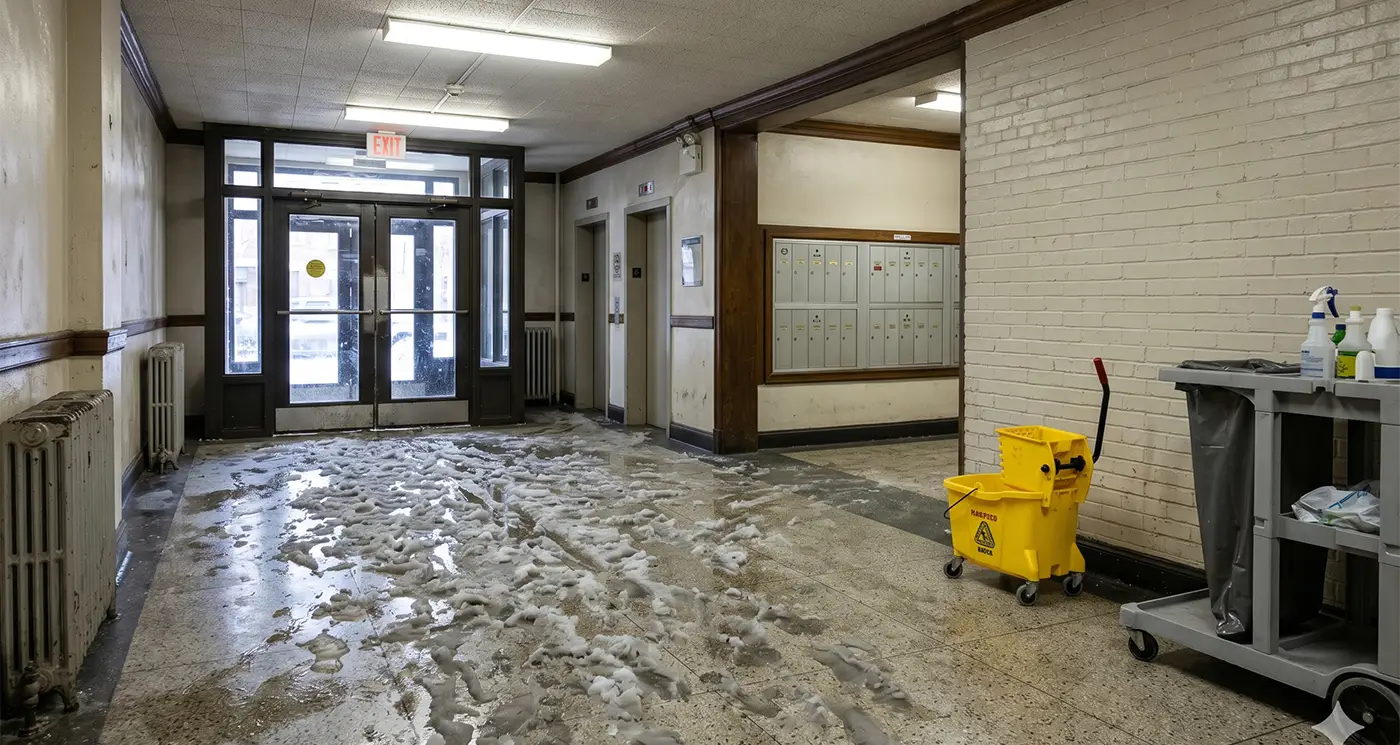
Many slip and fall cases begin with a simple condition that was not addressed in time: a freshly mopped floor without warning cones, a produce spill in a grocery store aisle, rainwater tracked into a building entrance where mats were missing or saturated, or a poorly lit stairwell where a broken step or loose handrail creates a fall hazard. In Sheepshead Bay’s commercial corridors, high foot traffic through stores, medical offices, and restaurants means that floor conditions can change rapidly — and that property operators have a corresponding duty to inspect regularly.
Winter and Weather-Related Falls
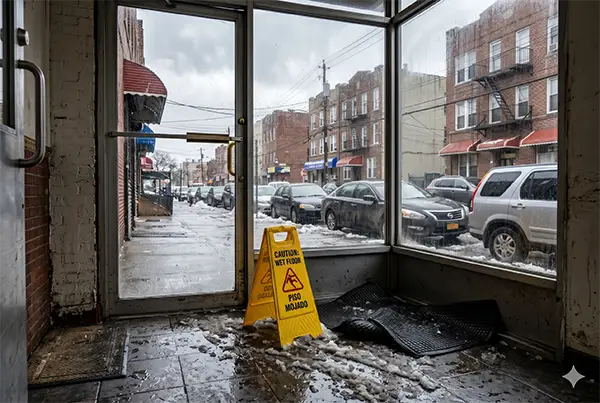
Winter conditions add a significant layer of risk. Snow and slush get tracked into lobbies, vestibules, and storefronts. Melt-and-refreeze cycles turn outdoor surfaces into invisible hazards. When cleanup is inconsistent — mats are saturated, salt application is spotty, or interior floors stay wet for hours — the risk is not just that someone slips, but that the owner cannot later show a reasonable inspection and cleaning routine.
Snow and Ice Removal in NYC
Under NYC Administrative Code § 16-123, property owners must clear sidewalks within specific timeframes after snowfall ends: within 4 hours if snow stops between 7:00 AM and 4:59 PM, by 9:00 AM if it stops between 5:00 PM and 8:59 PM, or by 11:00 AM if it stops between 9:00 PM and 6:59 AM. However, New York’s “storm-in-progress” doctrine generally protects property owners from liability while precipitation is actively falling. Weather records and precise timing become critical evidence in winter slip and fall cases.
Outdoor and Sidewalk Falls
Sidewalk falls in Sheepshead Bay can involve raised or cracked concrete flags, tree root damage, uneven pavement at curb cuts, ice accumulation, or debris from adjacent construction. These cases raise specific questions about property ownership and maintenance responsibility under New York City law. For more detail on how sidewalk cases are built across the borough, see our page on NY sidewalk slip and fall claims.
Common Slip and Fall Injuries
Slip and fall injuries are frequently more serious than people initially expect, particularly when the fall involves stairs, hard tile or concrete surfaces, or curb-height drops. The force of an uncontrolled fall onto a hard surface can produce injuries that require surgery, months of rehabilitation, or permanent lifestyle changes.
Fractures
Wrist, ankle, hip, and elbow fractures are among the most common fall injuries. Hip fractures in elderly patients can be life-altering, often requiring surgical repair and months of limited mobility.
Back and Neck Injuries
Herniated discs, cervical sprains, and lumbar injuries frequently follow slip and fall accidents. These injuries may not fully appear on imaging for days or weeks, making prompt medical evaluation and follow-up essential.
Traumatic Brain Injury (TBI)
When a person’s feet slide out and the head strikes a hard surface, the result can be a concussion or more severe brain injury. Symptoms like dizziness, headaches, memory problems, and light sensitivity require prompt neurological evaluation.
Knee and Shoulder Injuries
Torn ligaments, meniscus tears, and rotator cuff injuries result from twisting falls and attempts to brace against impact. These injuries often require surgical intervention and extended physical therapy.
From a legal standpoint, early medical documentation does more than prove you were hurt — it connects the fall to your symptoms, establishes functional limitations, and shows whether the injury is improving or becoming a chronic condition. For more on how specific diagnoses affect claim value, see our page on slip and fall injuries.
Who Is Legally Responsible for a Slip and Fall in Sheepshead Bay
Liability in a New York slip and fall case comes down to two core questions: who controlled the property where the fall occurred, and did that party have notice of the dangerous condition?
In New York premises liability cases, the injured person typically must show one of three things: (1) the defendant created the dangerous condition, (2) the defendant had actual notice — meaning they knew about the hazard, or (3) the defendant had constructive notice — meaning the condition was visible and existed long enough that a reasonable property owner would have discovered and corrected it. This is why cleaning logs, inspection schedules, and surveillance footage are critical evidence.
Potentially Liable Parties
The property owner bears the primary duty to maintain the premises in a reasonably safe condition. In Sheepshead Bay, this may be an individual landlord, a corporation, or a management entity. A commercial tenant — such as a restaurant, grocery store, or retail shop — may be liable for hazards within the leased space, particularly spills, wet floors, and inadequate warning signage.
A management company that controls building operations, maintenance schedules, and cleaning protocols can also be a defendant. Maintenance contractors — including cleaning services, snow removal companies, and repair vendors — may be liable when their work created or failed to address the hazard. For a detailed analysis of how responsibility is assigned, see our page on who is responsible for slip and fall in Brooklyn.
Sidewalk Falls and NYC Administrative Code § 7-210
Sidewalk falls in Sheepshead Bay raise a specific question that many people get wrong: who is responsible for maintaining the sidewalk?
Key Fact: Under NYC Administrative Code § 7-210, the abutting property owner — not the City of New York — is generally liable for injuries caused by failure to maintain the sidewalk in a reasonably safe condition. This includes the duty to repair cracked or raised sidewalk flags, remove snow and ice, and maintain the intersection quadrant for corner properties.
There is one important exception: owner-occupied one-, two-, or three-family residential properties used exclusively for residential purposes are exempt from § 7-210 liability. For those properties, different rules may apply and the City may retain some responsibility.
The City remains responsible for certain sidewalk-adjacent features including tree wells, pedestrian ramps, and the curb itself — none of which are considered part of the “sidewalk” under § 7-210. When tree root damage pushes up a sidewalk flag, the abutting property owner is typically responsible for the repair even though the City owns the tree.
Under CPLR § 214, the statute of limitations for a sidewalk fall claim against a private property owner is three years. However, if the fall occurred on city-owned property or in an area where the City retained responsibility, a Notice of Claim must be filed within 90 days. Identifying who owns and maintains the specific stretch of sidewalk is often the most important early step in a Sheepshead Bay sidewalk fall case.
Filing Deadlines and Special Rules
Government Property Falls
If your fall occurred on property owned or controlled by a government entity — including city-maintained sidewalks, public parks, subway stations, municipal buildings, or public housing — you must file a Notice of Claim within 90 days of the accident, and the lawsuit deadline is one year and 90 days. This issue can arise unexpectedly in Sheepshead Bay when a sidewalk that appears to be maintained by an adjacent business is actually city-owned property.
Comparative Negligence
New York follows a pure comparative negligence rule under CPLR § 1411. Even if the defense argues you were partly at fault — for not watching your step, wearing unsuitable footwear, or ignoring a warning sign — you can still recover damages. Your award is reduced by your percentage of responsibility. For more detail, see our explanation of what comparative negligence means in New York.
What to Do After a Slip and Fall in Sheepshead Bay
Most fall cases are won or lost in the first few weeks — not in the courtroom years later. Conditions change fast: a spill gets cleaned, salt gets applied, a mat gets repositioned, or a stairwell light gets replaced. If the hazard disappears before it is documented, the defense will argue there is no reliable proof of what caused the fall.
- Seek medical attention promptly. If you hit your head, felt a pop in your ankle or knee, or cannot bear weight on a limb, get evaluated right away. Early medical records tie symptoms to the fall and create a documented timeline.
- Photograph the hazard immediately. Take close-up photos of the exact condition — water, ice, debris, broken tile, or raised concrete — and wide shots showing your path of travel, lighting, and whether warning signs or mats were present.
- Report the incident to the property owner, store manager, or building superintendent. Ask for an incident report and keep your description factual.
- Collect witness names and contact information. In Sheepshead Bay businesses and apartment buildings, staff turnover means the employee who helped you at the scene may not be there later when questions arise.
- Preserve your clothing and footwear. Defense teams often argue that the fall was caused by inappropriate shoes. Keep what you were wearing in case it becomes relevant evidence.
- Request surveillance footage preservation immediately. Many commercial and residential building camera systems overwrite footage within 30 days or less. A written preservation request — or a letter from an attorney — can prevent the loss of critical evidence.
- Contact an attorney before the scene changes. A timely investigation can identify the property owner, locate cameras, send preservation letters, and request maintenance and inspection records.
For a step-by-step guide, see how to respond after a fall accident.
Injured in a Slip and Fall in Sheepshead Bay?
If you were hurt because a property owner failed to maintain safe conditions, evidence may be disappearing right now. Contact us for a free case evaluation to understand your rights and preserve critical proof.
Get a Free ConsultationCompensation You May Recover
Damages in a Sheepshead Bay slip and fall case address both the financial cost of the injury and its impact on your daily life. The value depends on the medical evidence, the clarity of liability, and how the injury changed your ability to work and function.
Economic damages include medical bills, rehabilitation costs, prescription medications, out-of-pocket expenses, and lost wages from missed work. Non-economic damages address pain and suffering, limitations on daily activities, and loss of enjoyment of life. Future damages apply when the injury requires ongoing treatment, additional surgery, or creates long-term functional limitations.
Insurers often focus narrowly on what they can quantify — the ER bill, the number of therapy visits — while minimizing the real-world impact. Documenting work restrictions, missed time, caregiving limitations, and day-to-day difficulties is essential to recovering fair compensation. For a plain-language explanation, see our guide to what non-economic damages are.
How Our Lawyers at the Law Office of Irene H. Gabo, P.C. Can Help
In a slip and fall case, our role is to find the facts the defense will not volunteer, preserve evidence before it vanishes, and present the case in a way that makes sense to an insurance adjuster, a judge, or a jury.
Early Investigation and Evidence Preservation
We locate and secure surveillance footage, send preservation letters to property owners and management companies, identify all responsible parties (owner, tenant, management, contractors), and request maintenance logs, inspection records, and cleaning schedules.
Establishing Notice and Liability
We investigate whether the property owner created the hazard, had actual notice, or should have known about it through reasonable inspection. Prior complaints, 311 records, building violations, and internal maintenance documentation all contribute to the notice analysis.
Building the Medical Case
Many fall cases begin with a diagnosis of “sprain” or “strain” — and more serious findings appear later on MRI. We connect the timeline clearly, document functional limitations, and establish future treatment needs when supported by the medical evidence.
Negotiation and Litigation
We pursue maximum recovery through negotiation with property insurance carriers and, when necessary, through litigation to obtain records, depose witnesses, and present the case to a jury.
Contact Us Today to Discuss Your Rights and Whether You are Entitled to Compensation
For a broader overview of how we handle premises liability cases across Brooklyn, see our Brooklyn slip and fall premises liability page. To discuss your case, visit our contact page or call (800) 560-0214.
Frequently Asked Questions
Most slip and fall lawsuits in New York must be filed within three years of the date of the accident under CPLR § 214. However, if your fall occurred on government-owned property, a Notice of Claim must be filed within 90 days under General Municipal Law § 50-e, and the lawsuit deadline shortens to one year and 90 days. Even when you have time legally, waiting can damage your case because video, witness information, and maintenance records may be lost.
Under NYC Administrative Code § 7-210, the abutting property owner is generally responsible for maintaining the sidewalk in a reasonably safe condition — including repairing cracked or raised flags and removing snow and ice. Owner-occupied one-, two-, or three-family residential properties used exclusively for residential purposes are exempt. Identifying ownership early is critical because it determines who is sued and which filing deadlines apply.
In most cases, yes. You can establish liability by showing the owner created the condition, had actual knowledge of it, or had constructive notice — meaning the hazard was visible and existed long enough that a reasonable owner would have discovered and corrected it. Cleaning logs, inspection schedules, prior complaints, and surveillance footage are the most common forms of evidence used to prove notice.
A warning sign does not automatically defeat a claim. The legal questions are whether the sign was positioned where you could see it from your direction of approach, and whether the property owner had a continuing duty to correct the unreasonably dangerous condition rather than merely warn about it. A sign placed behind a spill or around a corner may not provide adequate warning.
Surveillance footage can be the strongest evidence in a fall case because it may show the hazardous condition, the fall itself, and whether staff inspected or cleaned the area beforehand. The problem is that many commercial and residential building camera systems record over footage within approximately 30 days. A timely preservation request — ideally from an attorney — is often the difference between having video evidence and losing it permanently.
Yes, in most cases. New York follows a pure comparative negligence rule under CPLR § 1411, meaning you can recover damages even if you were partly at fault. Your compensation is reduced by your share of responsibility. The defense commonly argues “open and obvious” hazards or inattention, but these arguments do not automatically eliminate the property owner’s duty to maintain safe premises.
The timeline depends on the severity of injuries, how clear the liability evidence is, and whether the insurer is willing to negotiate fairly. Many cases take several months to resolve through negotiation, and some require litigation — including discovery, depositions, and trial — to obtain key records and testimony. Cases typically move faster when evidence is preserved early and medical documentation is consistent.