







Motorcycle accidents in Brighton Beach frequently involve high-speed corridors, congested commercial streets, and complex intersection layouts that put riders at serious risk. If you or a loved one was injured in a motorcycle crash in Brighton Beach, understanding New York’s insurance rules and filing deadlines is critical to protecting your right to compensation.
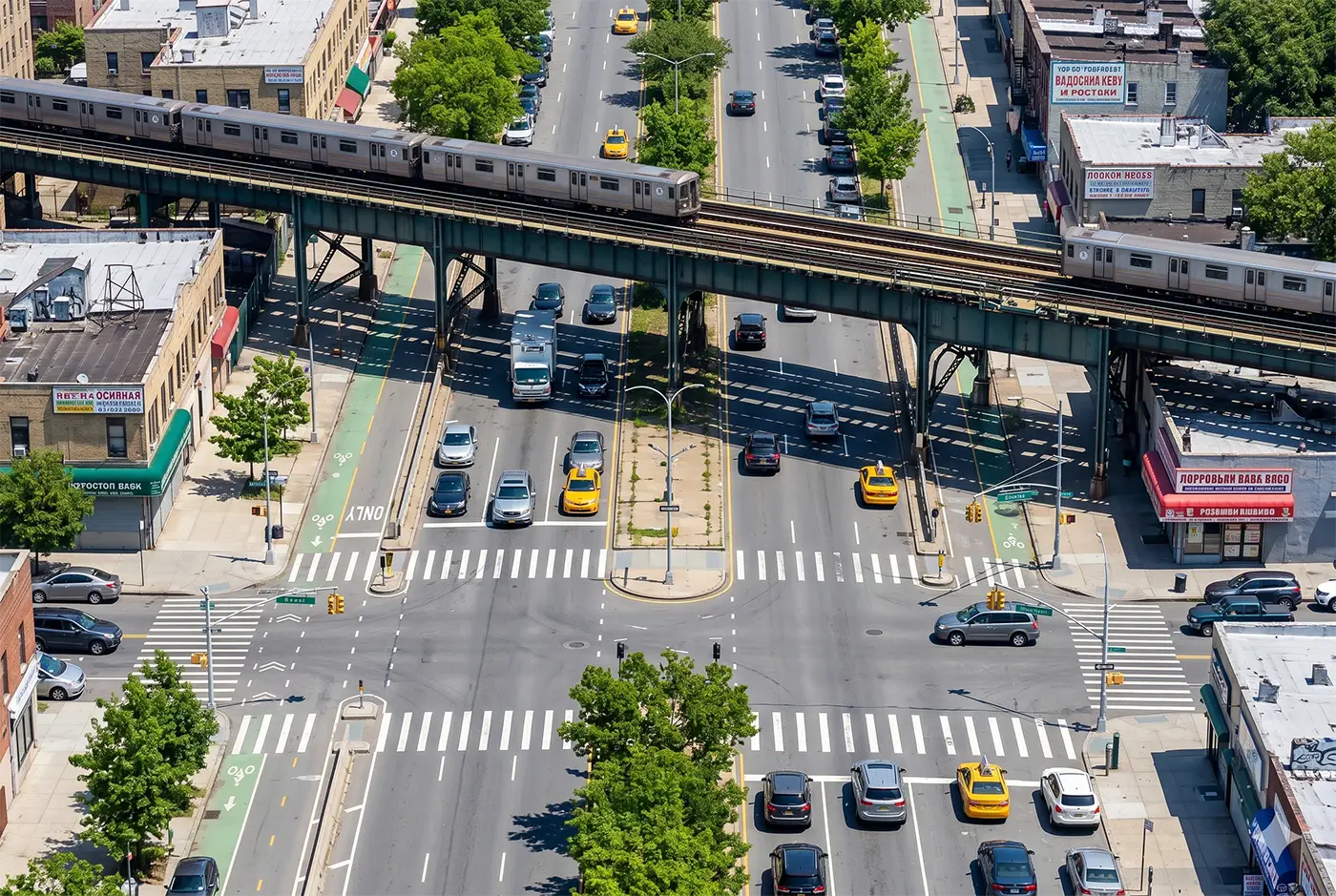
Where Motorcycle Crashes Happen in Brighton Beach
Brighton Beach sits within the NYPD’s 60th Precinct, which covers Coney Island, Brighton Beach, West Brighton Beach, and Sea Gate across 3.4 square miles of Brooklyn’s southern coastline. The neighborhood’s geography funnels motorcycle traffic through a handful of high-risk corridors where cars, commercial vehicles, and pedestrians all compete for limited road space.
Brighton Beach Traffic Corridors
The Belt Parkway runs along Brighton Beach’s northern edge and is one of the most dangerous roads for motorcyclists in southern Brooklyn. Riders exiting the parkway near Brighton Beach Avenue or Ocean Parkway encounter sharp curves and merging traffic. Brighton Beach Avenue itself, which runs beneath the elevated B and Q subway tracks, creates limited visibility conditions – shadows from the overhead structure obscure lane markings and make it harder for drivers to see motorcycles.
Ocean Parkway, which terminates near Brighton Beach at its southern end, is a wide multi-lane boulevard where vehicles routinely exceed the posted 25 mph speed limit. Motorcyclists traveling south on Ocean Parkway toward Brighton Beach encounter pedestrians crossing between the parkway’s divided lanes, turning vehicles, and double-parked cars near commercial blocks.
Coney Island Avenue, running north-south along Brighton Beach’s western boundary, carries heavy commercial and delivery traffic. Riders navigating this corridor face frequent hazards from trucks making deliveries, vehicles pulling out from parking spots, and congested intersections near the B/Q subway station at Brighton Beach.
Liability and Insurance Rules
New York is a no-fault insurance state, but the no-fault system applies differently to motorcyclists. Unlike drivers and passengers in cars, motorcyclists are not covered by the mandatory Personal Injury Protection (PIP) insurance that vehicle owners carry under Insurance Law § 5103. This means that if you are injured in a motorcycle crash, you cannot file a claim under the at-fault driver’s PIP policy for basic medical expenses and lost wages the same way a car occupant would.
However, if a motorcyclist is struck by a motor vehicle, the motorcyclist may access the vehicle driver’s no-fault benefits under certain circumstances. The practical result is that motorcycle accident claims in New York often proceed directly as personal injury lawsuits rather than through the no-fault system.
New York follows a pure comparative negligence standard under CPLR § 1411. A motorcyclist can recover compensation even if they were partially at fault for the crash. The award is reduced by the rider’s percentage of fault – for example, a rider found 20% at fault for a $500,000 claim would receive $400,000.
Liability in Brighton Beach motorcycle accidents often involves multiple parties. A driver who failed to check a blind spot before turning, a property owner who allowed debris to accumulate near a driveway exit, or the City of New York for a poorly maintained road surface may each bear responsibility. An experienced attorney can investigate the crash to identify all potentially liable parties.
New York’s Serious Injury Threshold
To pursue a personal injury claim beyond no-fault benefits in New York, a motorcycle accident victim must demonstrate a “serious injury” as defined by Insurance Law § 5102(d). Given the lack of structural protection a motorcycle offers, riders frequently sustain injuries that meet or exceed this threshold.
Key Fact: New York’s serious injury threshold includes death, dismemberment, significant disfigurement, fractures, permanent loss or limitation of a body organ or function, and injuries that prevent the victim from performing substantially all of their daily activities for at least 90 of the 180 days following the accident.
Common Motorcycle Accident Injuries
Motorcyclists have virtually no structural protection between their body and the road or another vehicle. Even at relatively low speeds, the injuries sustained in a motorcycle crash tend to be significantly more severe than those in typical car accidents.
Traumatic Brain Injury (TBI)
Head impacts against pavement, vehicles, or fixed objects can cause concussions, skull fractures, and severe brain injuries. TBI is the leading cause of death in motorcycle accidents, even among helmeted riders.
Spinal Cord Injuries
The violent forces involved in motorcycle crashes can damage vertebrae, discs, and the spinal cord itself, potentially resulting in partial or complete paralysis requiring lifelong medical care and adaptive equipment.
Fractures and Orthopedic Injuries
Broken legs, arms, wrists, collarbones, and pelvic fractures are among the most common motorcycle crash injuries. Compound fractures may require surgical repair with pins, plates, or rods and months of rehabilitation.
Road Rash and Soft Tissue Damage
When a rider slides across pavement, the friction can strip away skin down to muscle or bone. Severe road rash often requires skin grafts and can lead to permanent scarring, nerve damage, and chronic pain.
Internal Organ Damage
Blunt force trauma from a collision can cause internal bleeding, ruptured organs, or damage to the liver, spleen, or kidneys. These injuries may not produce immediate symptoms but can become life-threatening without prompt treatment.
Damages Available to Injured Riders

Motorcycle accident victims who establish liability and meet the serious injury threshold may pursue compensation for economic and non-economic losses, including medical expenses (past and future), lost wages and loss of earning capacity, pain and suffering, emotional distress, and loss of enjoyment of life. In wrongful death cases, surviving family members may pursue a separate claim under EPTL § 5-4.1.
Because motorcycle injuries tend to be severe, the medical costs alone can reach into the hundreds of thousands of dollars. Future care needs – ongoing physical therapy, assistive devices, home modifications, or long-term nursing care – must be carefully calculated and documented by medical experts to ensure the full scope of damages is captured in any settlement demand or trial presentation.
What to Do After a Motorcycle Crash in Brighton Beach
- Call 911 and wait for NYPD and EMS. Brighton Beach falls within the 60th Precinct. A police report creates an official record of the crash, which is essential for any insurance claim or lawsuit.
- Seek immediate medical attention. Coney Island Hospital (NYC Health + Hospitals/South Brooklyn Health) is the closest emergency facility. Even if injuries seem minor, get evaluated – internal injuries and TBI symptoms often have delayed onset.
- Document the scene. If you are physically able, photograph the road surface, vehicles, your motorcycle, traffic signals, skid marks, debris, and any visible injuries. Wide-angle shots showing the surrounding area are especially valuable.
- Exchange information but limit conversation. Get the other driver’s name, license, plate number, and insurance details. Do not discuss fault or apologize at the scene.
- Preserve your gear. Your helmet, jacket, gloves, and boots are physical evidence. Do not clean, repair, or discard them.
- Do not post on social media. Insurance adjusters routinely monitor claimants’ accounts. A single post can be taken out of context to minimize your claim.
- Contact a motorcycle accident attorney. An attorney experienced with Brighton Beach and southern Brooklyn crash patterns can preserve evidence, send spoliation notices for camera footage, and protect your filing deadlines.
Filing Deadlines
Critical Filing Deadlines
The statute of limitations for most personal injury claims in New York is three years from the date of the accident under CPLR § 214. However, if a government entity was involved – such as a city bus, an MTA vehicle, or a dangerous road condition the city failed to repair – you must file a Notice of Claim within 90 days under General Municipal Law § 50-e, and the lawsuit must be filed within one year and 90 days. Missing the Notice of Claim deadline permanently bars the claim against the government entity.
For wrongful death claims, the statute of limitations is two years from the date of death under EPTL § 5-4.1. Given the shortened deadlines for government entity claims, injured riders should consult an attorney as soon as possible after the crash.
Injured in a Motorcycle Accident in Brighton Beach?
The Law Office of Irene H. Gabo, P.C. represents motorcycle accident victims throughout Brighton Beach and southern Brooklyn. Contact us for a free case evaluation – there is no fee unless we recover compensation for you.
Get a Free ConsultationFrequently Asked Questions
No-fault PIP coverage does not apply to motorcyclists the same way it does to car occupants. Motorcyclists are excluded from mandatory PIP under Insurance Law § 5103. However, a motorcyclist struck by a motor vehicle may be able to access the vehicle driver’s no-fault benefits under certain circumstances. Because of this gap, motorcycle accident claims in New York often proceed directly as personal injury lawsuits.
Yes. New York follows a pure comparative negligence rule under CPLR § 1411, meaning you can recover damages even if you were partially at fault. Your compensation will be reduced by your percentage of fault. For example, if you are found 30% at fault for the crash, your recovery is reduced by 30%.
If a dangerous road condition contributed to your crash, the City of New York or the state agency responsible for maintaining the road may be liable. However, claims against government entities require filing a Notice of Claim within 90 days of the accident under General Municipal Law § 50-e. You may also need to demonstrate that the government entity had prior written notice of the hazardous condition in some cases. An attorney can help investigate 311 complaints, DOT records, and maintenance logs for the specific stretch of road where your accident occurred.
The statute of limitations for personal injury claims is three years from the date of the accident. For wrongful death, it is two years from the date of death. If a government entity is involved, the Notice of Claim must be filed within just 90 days of the incident. Because evidence disappears quickly – skid marks fade, vehicles are repaired, and surveillance footage is overwritten – it is important to consult an attorney as soon as possible after the crash.