







Trip and Fall Accidents at Newtown Barge Playground Waterfront in Greenpoint
A trip and fall at Newtown Barge Playground Waterfront raises important questions about public space maintenance, surface defects, lighting, and who controlled the area where the fall happened. This Greenpoint waterfront location is not a boardwalk, but it does include paths, paved areas, play spaces, entrances, and nearby waterfront walking routes where uneven surfaces can create real hazards.
Because Newtown Barge Playground Waterfront is a public waterfront space, the legal process may be different from a fall inside a private store or apartment building. Claims involving New York City, NYC Parks, or another public entity can require a Notice of Claim within 90 days. If the injury happened in a public place or may involve a city agency, deadlines can be shorter than expected. Contact Law Office of Irene H. Gabo, P.C. at 800-560-0214 for guidance.
Trip and fall cases are not won by simply showing that someone fell. The facts must show what caused the fall, how long the condition existed, who had responsibility for the area, and whether the hazard should have been fixed or warned about sooner.
How Trip and Fall Accidents Happen at Newtown Barge Playground Waterfront
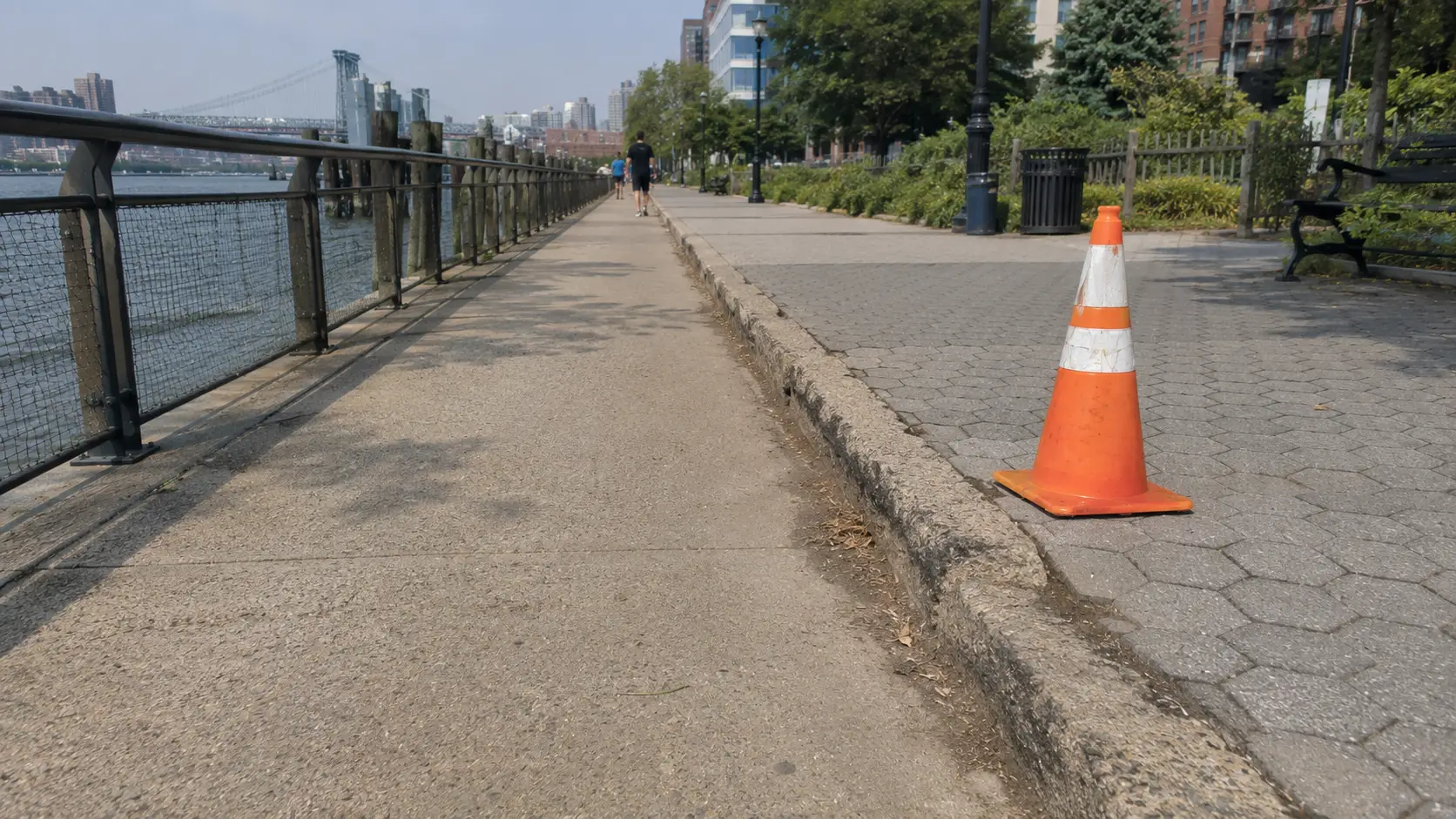
Newtown Barge Playground Waterfront sees families, walkers, cyclists passing nearby, and residents using the Greenpoint waterfront for recreation. Heavy use can make small surface problems more dangerous. A raised pavement edge, cracked walkway, loose paver, or uneven transition near an entrance can catch a foot before a visitor has time to react.
Waterfront conditions also matter. Rain, freezing temperatures, salt air, drainage problems, and frequent foot traffic can affect paved surfaces over time. In colder months, freeze-thaw cycles may worsen cracks or lift sections of pavement. In warm or humid weather, pooling water and worn surfaces can still reduce traction and visibility.
Common trip hazards at locations like Newtown Barge Playground Waterfront may include broken pavement, raised utility covers, gaps between paved sections, poor lighting near paths, loose mats or temporary coverings, and uneven surfaces near playground or waterfront access points. These details are similar to issues discussed in our guide to trip and fall accidents on sidewalks, although public park property can involve different procedural rules.
The location of the defect can change the case strategy. A defect on a city-controlled path may require proof of prior written notice or evidence that the city affirmatively created the condition. A defect near an adjacent private property line may require reviewing ownership records, maintenance agreements, and whether any contractor recently worked on the area.
Common Injuries After a Trip and Fall in Greenpoint
Trip and fall injuries often happen fast because the body has little time to brace. People commonly suffer wrist fractures, shoulder injuries, knee damage, ankle injuries, hip fractures, back injuries, and head trauma. At a waterfront public space, hard pavement and uneven transitions can make the impact more serious.
Medical records are important because they connect the fall to the injury. Emergency room notes, orthopedic evaluations, imaging studies, physical therapy records, and specialist reports can show whether the injury is temporary or long-lasting. A delayed diagnosis can create arguments for the defense, especially if the person continued walking or did not seek treatment right away.
Functional limitations often matter as much as the diagnosis. A fractured wrist may affect work, childcare, driving, or basic daily tasks. A knee injury may limit walking along Greenpoint streets, using stairs, or returning to recreational activities. Lawyers look for records that show how the injury changed the person’s life, not just what appeared on an X-ray.
Some injuries become more significant over time. A person may initially feel embarrassed and leave the scene, only to develop severe pain later. That is why prompt medical treatment and consistent follow-up can strengthen a claim and reduce disputes over causation.
Who May Be Legally Responsible for a Waterfront Trip and Fall
New York premises liability law focuses on responsibility, notice, causation, and damages. In a trip and fall case, the central question is whether the responsible party failed to maintain a reasonably safe area and whether that failure contributed to the injury. At Newtown Barge Playground Waterfront, the answer may depend on whether the defect was on city-controlled park property, a sidewalk, a path, or an area maintained by a contractor.
Property owners and controlling entities must use reasonable care to keep public areas safe. For private property, liability often depends on actual notice, constructive notice, or proof that the owner created the condition. Constructive notice means the hazard was visible and present long enough that it should have been found and corrected.
Public property adds another layer. If NYC Parks, the City of New York, or another municipal entity controlled the area, special claim rules may apply. Public entities are not automatically liable for every defect. The case may require proof that the city had prior written notice, created the defect through work performed in the area, or failed to address a known dangerous condition.
Adjacent property owners may also matter in some sidewalk cases. Under NYC Admin Code §7-210, many adjacent property owners are responsible for sidewalk maintenance. There is an exception for certain one-, two-, or three-family owner-occupied residential properties. Around a waterfront public space, an attorney may need to compare maps, maintenance records, and property boundaries before deciding who should be named in the claim.
These issues overlap with broader premises liability principles explained on our Brooklyn slip and fall premises liability lawyers page. The key difference is that a Greenpoint public waterfront setting may trigger city deadlines and agency record requests that do not apply to ordinary private claims.
What Happens After a Fall at Newtown Barge Playground Waterfront
The first few days after a fall can shape the entire case. The surface may be repaired, weather may change the area, temporary warnings may be removed, or witnesses may become difficult to locate. At Newtown Barge Playground Waterfront, a hazard near a path or playground entrance may look different by the time an investigator returns.
Reporting matters. If the fall was reported to park staff, 311, NYC Parks, EMS, or NYPD, those records may help confirm when and where the event happened. But reports can be incomplete. They may not describe the exact defect, lighting, measurements, or the person’s footwear. That is why photographs and witness information remain important.
Video evidence may exist, but it can be hard to identify and preserve. Nearby buildings, public cameras, businesses, or construction sites may have footage facing the waterfront or surrounding streets. Camera footage in New York City may be overwritten in 30 days or less, and public agency footage may require a FOIL request or other formal demand.
Early decisions also affect leverage. Giving a vague statement, guessing about the cause, or failing to photograph the defect can make the defense stronger. A careful account should focus on observable facts: where the foot caught, what the surface looked like, lighting conditions, weather, and whether there were cones, barriers, or warning signs.
Common mistakes include waiting too long to seek treatment, assuming the city will automatically investigate, leaving without witness names, or returning weeks later after the defect changed. A lawyer can help preserve evidence before the responsible party has a chance to argue that the scene no longer proves anything.
Special New York Rules for Public Waterfront Trip and Fall Claims
Most New York personal injury cases have a three-year statute of limitations. However, claims against New York City or a public agency have much shorter rules. When a city agency or public authority is responsible for the injury, a Notice of Claim must usually be filed within 90 days, and the lawsuit deadline is generally one year and 90 days.
These deadlines can apply to public parks, waterfront public spaces, city-owned paths, and other government-controlled locations. Missing the Notice of Claim deadline can seriously limit or end the case before the facts are fully investigated. This is one reason a fall at Newtown Barge Playground Waterfront should be evaluated quickly.
New York also follows pure comparative negligence under CPLR §1411. That means an injured person can still recover damages even if they were partly at fault. The recovery is reduced by the person’s percentage of responsibility. For example, the defense may argue the defect was open and obvious, that the person was looking at a phone, or that lighting was sufficient.
Comparative negligence does not automatically defeat a claim. It changes the value and proof issues. Photographs, measurements, lighting evidence, and witness statements can help show why the hazard was not reasonably avoidable. You can learn more about shared fault in our resource on comparative negligence in New York.
For trip and fall cases, surface height is also important. NYC rules often focus on whether a sidewalk or walking surface had a height differential greater than one-half inch. A smaller defect may still matter depending on location, lighting, crowding, and surrounding conditions, but measurements should be taken before repairs occur.
What To Do After a Trip and Fall at Newtown Barge Playground Waterfront
Start by getting medical care. Even if pain seems manageable, conditions such as fractures, ligament tears, concussions, and back injuries may worsen after the adrenaline fades. Medical records also create a timeline that helps connect the injury to the Greenpoint fall.
Photograph the exact hazard from several angles. Include a close photo, a wider photo showing the surrounding area, and a measurement reference if it is safe to do so. A coin, ruler, shoe, or other object can help show the height change, gap, or uneven edge.
Report the incident to the proper entity. For a public waterfront location, that may involve NYC Parks, 311, NYPD, EMS, or another agency depending on what happened. Keep copies of report numbers, emails, medical discharge papers, and any photographs sent to city agencies.
Look for witnesses before leaving the area. A parent at the playground, a passerby on the path, a nearby worker, or another visitor may have seen the fall or noticed the defect before. Witnesses can be especially helpful when the city later claims it had no notice of the unsafe condition.
Preserve your shoes and clothing. The defense may question footwear, visibility, or whether the person was walking carefully. Keeping the shoes worn at the time of the fall can prevent unfair speculation later.
For a fuller checklist, review our guide on how to respond after a trip and fall accident. A strong claim often depends on early evidence preservation. Call Law Office of Irene H. Gabo, P.C. at 800-560-0214 to discuss what records, photos, or deadlines may matter in your case.
How Our Lawyers at Law Office of Irene H. Gabo, P.C. Can Help
Our lawyers begin by identifying the exact location of the fall and who controlled it. At Newtown Barge Playground Waterfront, that may require reviewing public property records, park boundaries, maintenance responsibilities, and whether any private contractor performed recent work nearby.
We also focus on evidence preservation. That includes photographs, witness statements, 311 history, agency records, FOIL requests, maintenance logs, inspection records, and any available surveillance footage. The goal is to determine whether the defect was known, visible, recurring, or created by work in the area.
Trip and fall cases often turn on details that seem small at first. The height of a raised edge, the direction of travel, shadows at dusk, wet conditions near the waterfront, or the absence of warning cones can all matter. Our team evaluates those facts before the defense frames the fall as simple clumsiness.
We also prepare the case for litigation from the beginning. That means identifying all responsible parties, tracking deadlines, requesting records, and building a clear damages picture. If the case involves a municipal defendant, we address the Notice of Claim requirement and shortened lawsuit deadline early.
Compensation You May Recover After a Greenpoint Trip and Fall
The damages available depend on the nature of your injuries and how they have affected your life. Common categories include medical expenses, lost wages, pain and suffering, and reduced earning capacity. In a serious fall, future medical care and long-term limitations may also be part of the claim.
Economic damages include ambulance bills, hospital care, surgery, orthopedic treatment, imaging, physical therapy, medication, and lost income. If the injury affects your ability to work in the future, reduced earning capacity may also be considered.
Non-economic damages address the human impact of the injury. This may include pain, loss of mobility, anxiety about falling again, sleep disruption, and reduced enjoyment of daily activities. For someone who used the Greenpoint waterfront for walking, exercise, or family time, those losses can be meaningful.
Future damages require careful documentation. A doctor may need to explain whether the injury is permanent, whether more treatment is likely, and how the condition affects daily function. The stronger the medical record, the harder it is for the defense to minimize the long-term impact.
Limits and Case Viability in Public Waterfront Fall Claims
Not every fall leads to a viable legal claim. A case depends on liability, proof, deadlines, and damages. If the surface was not defective, if the hazard cannot be identified, or if the deadline was missed, recovery may be limited.
Public property cases can be especially demanding. The city may argue it lacked prior written notice, did not control the exact area, or had no reasonable opportunity to repair the condition. Those defenses must be addressed with records, photographs, maps, and witness accounts.
Insurance coverage and defendant identity also matter. A contractor, adjacent owner, city agency, or maintenance company may each have different responsibilities. Naming the wrong party or waiting too long to investigate can weaken a claim before it begins.
A practical case review looks at the full picture: what caused the fall, who controlled the area, how serious the injury is, what evidence still exists, and which deadlines apply. That review helps determine whether the case can move forward with confidence.
Contact a Greenpoint Trip and Fall Lawyer
A fall at Newtown Barge Playground Waterfront can involve public property rules, changing scene conditions, and strict New York deadlines. Speaking with a lawyer early can help protect evidence and clarify who may be responsible.
To discuss your case, call Law Office of Irene H. Gabo, P.C. at 800-560-0214.
Frequently Asked Questions About Newtown Barge Playground Waterfront Trip and Fall Claims
Does a Fall at Newtown Barge Playground Waterfront Have a Shorter Deadline Than a Private Property Case?
It may. If New York City, NYC Parks, or another public entity controlled the area, a Notice of Claim may need to be filed within 90 days. The lawsuit deadline is generally one year and 90 days for municipal claims.
What Proof Helps Show That a Waterfront Path Defect Caused My Fall?
Helpful proof includes photos of the defect, measurements, witness names, medical records, and reports made to 311 or park personnel. Video from nearby buildings or cameras may also matter. The sooner this evidence is collected, the stronger the claim may be.
Can I Still Recover Compensation If I Was Looking Around the Playground or Waterfront?
Yes, depending on the facts. New York uses pure comparative negligence, so partial fault reduces recovery but does not automatically bar it. The key issue is whether the defect was dangerous and whether it should have been repaired or marked.
Who Is Responsible for Maintaining Public Waterfront Walking Areas in Greenpoint?
Responsibility depends on the exact location of the defect. It may involve NYC Parks, the City of New York, an adjacent property owner, or a contractor. A lawyer may need to review maps, maintenance records, and agency documents to identify the correct parties.
Should I Report the Fall Even If I Already Went Home?
Yes, reporting the fall can still help create a record. Keep the report number and write down what you remember about the location, weather, lighting, and surface condition. You should also seek medical care and preserve any photos or witness information.
What Damages Are Available in a Greenpoint Trip and Fall Case?
Recoverable damages may include medical bills, lost wages, pain and suffering, and future treatment needs. If the injury causes long-term limits, reduced earning capacity may also be considered. The value depends on liability proof and the medical record.