







Trip and Fall Injuries at Marsha P. Johnson State Park Waterfront
Imagine walking along the East River at Marsha P. Johnson State Park Waterfront expecting a normal visit, only for an uneven path, raised edge, broken surface, or poorly marked event area to change the day. Waterfront parks in Williamsburg and Greenpoint draw steady foot traffic, seasonal events, cyclists, families, and visitors moving between paths, lawns, and entrances.
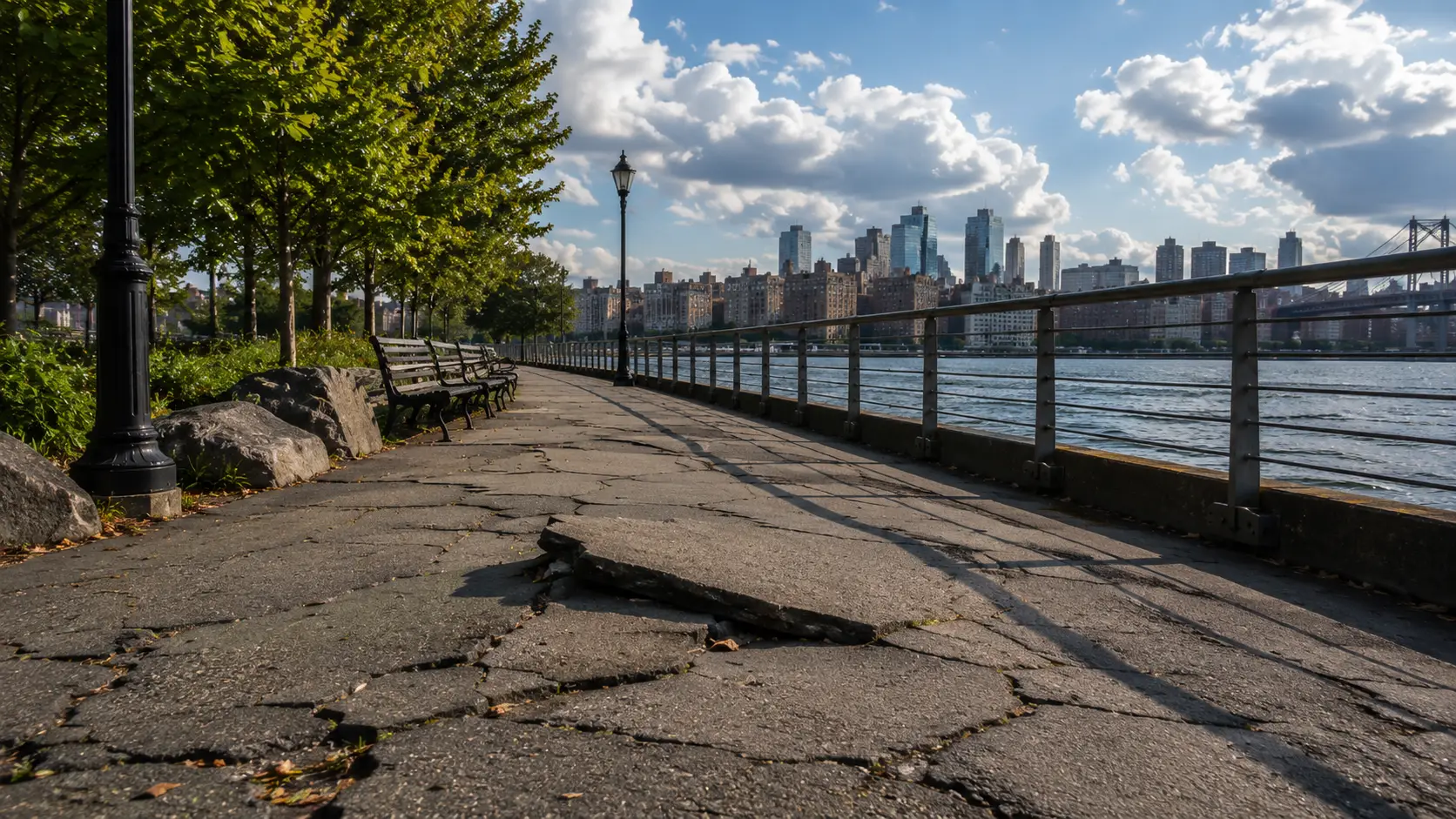
A trip and fall at Marsha P. Johnson State Park Waterfront raises important questions about who controlled the area, how long the condition existed, whether prior complaints were made, and whether the hazard should have been repaired or marked. For questions about evidence, deadlines, or who may be responsible, call Law Office of Irene H. Gabo, P.C. at 800-560-0214.
These cases are not proven by the fall alone. New York law requires proof that a dangerous condition existed, that the responsible party knew or should have known about it, or that the responsible party created it. That proof often depends on photos, measurements, maintenance records, witness statements, and reports made shortly after the incident.
How Trip and Fall Accidents Happen at Marsha P. Johnson State Park Waterfront
Marsha P. Johnson State Park Waterfront includes walking paths, open event areas, waterfront access points, and surfaces affected by weather and heavy use. Along the East River, pavement and walkway materials can shift over time because of moisture, freeze-thaw cycles, drainage issues, and repeated pedestrian traffic.
Common hazards include raised pavement seams, cracked walking paths, uneven transitions between hard surfaces and event areas, loose pavers, damaged curbs, poorly lit sections, and temporary equipment placed for public events. A small height difference can become dangerous when visitors are looking toward the water, walking through a crowd, or moving around tables, fencing, cables, mats, or vendor setups.
Trip and fall claims near waterfront parks often involve both environmental conditions and maintenance practices. Rain can pool near walkway edges, winter conditions can worsen cracks, and high-use paths can deteriorate faster than quieter park areas. These conditions matter because the more predictable the hazard, the stronger the argument that reasonable inspections should have found it.
For broader information about New York walkway and sidewalk hazards, our page on New York sidewalk slip and fall claims explains how uneven surfaces and maintenance failures are often evaluated.
Common Injuries After a Waterfront Park Fall in Williamsburg and Greenpoint
Falls often result in fractures, especially to wrists, hips, ankles, and shoulders. Many people instinctively reach out to break the fall, which can lead to hand, elbow, or arm injuries. Head injuries and back injuries can also occur when someone lands on a hard walkway or strikes a curb, railing, bench, or uneven surface.
The legal importance of the injury is not limited to the diagnosis. Medical records help connect the fall at Marsha P. Johnson State Park Waterfront to the harm claimed. Imaging, emergency room notes, orthopedic evaluations, physical therapy records, and follow-up treatment all help show how the injury affected daily life.
Functional limitations also matter. A fractured ankle may affect walking, commuting, childcare, or work. A back injury may limit lifting, sitting, or standing. Lawyers look at how the injury changed the person’s routine, whether the condition is permanent, and whether future care may be needed.
You can also review our discussion of common injuries in Brooklyn trip and fall accidents for more detail on how medical proof supports these claims.
Who May Be Legally Responsible for a Fall at Marsha P. Johnson State Park Waterfront
Responsibility depends on control. In a waterfront park case, the liable party may be the public entity responsible for the park, a maintenance contractor, an event organizer, a vendor, or another party that created or failed to correct the hazardous condition. The first task is identifying who controlled the exact location where the fall occurred.
New York premises liability law requires showing that a dangerous condition caused the fall and that the responsible party had actual notice, constructive notice, or created the condition. Actual notice means someone knew about the specific hazard. Constructive notice means the hazard was visible and present long enough that reasonable inspection should have found it.
Owner-created hazards are handled differently. If workers, contractors, or event staff placed a cable, raised mat, temporary platform, loose barrier, or uneven covering in a walkway, a separate notice argument may not be needed. The key is showing that the condition existed because of the responsible party’s own conduct.
Sidewalk and public walkway rules can also matter around entrances and adjoining pedestrian areas. In New York City, NYC Admin Code §7-210 generally places sidewalk maintenance duties on adjacent property owners, with exceptions for certain owner-occupied one-, two-, and three-family homes. City-owned property defects can involve additional proof issues, including prior written notice requirements.
Because Marsha P. Johnson State Park Waterfront is a public waterfront park, the government-versus-private distinction should be reviewed early. Public property claims can follow different procedures than claims against a private building or store. Our Brooklyn trip and fall accident lawyers page explains how these liability issues fit into a broader premises case.
What Happens After a Trip and Fall at a Busy Waterfront Park
This type of situation unfolds quickly. The dangerous condition may be repaired, covered, cleaned, moved, or altered before the injured person has a chance to return. Temporary event layouts may be removed the same day. Rain, crowds, or maintenance crews may change the scene within minutes.
The first days after a fall at Marsha P. Johnson State Park Waterfront are important. A report should be made to park staff, security, event personnel, or the agency responsible for the location. The report should identify the precise area, such as a path section, entrance, curb transition, event area, or waterfront walkway.
Photos should show the defect from several angles. A close photo helps show the height difference or broken surface. A wider photo helps connect the defect to the surrounding park layout. A measurement reference, such as a ruler, coin, or shoe, can help show whether the defect was more than a minor irregularity.
Witness names and phone numbers are also important. In a public waterfront area, many people may see the fall but leave before a formal report is prepared. Their observations can help prove the condition was visible, unmarked, or present before the fall happened.
Insurance companies and defense lawyers often focus on delay. They may argue that the condition cannot be verified, that the person fell for another reason, or that the defect was open and obvious. Early documentation makes those arguments harder to rely on.
Special New York Rules That May Affect Your Claim
Most New York personal injury cases must be filed within three years from the date of injury. That general deadline applies to many private premises liability claims. However, claims involving government entities can have much shorter time limits and different procedural steps.
Claims against New York City, the MTA, NYCHA, NYC public schools, NYC Parks, or other city agencies require a Notice of Claim within 90 days and a lawsuit within one year and 90 days. Marsha P. Johnson State Park Waterfront requires careful review because public waterfront property may involve a government-controlled location. The controlling entity must be identified before deadlines can be safely evaluated.
Government-related cases may also require requests for agency records. In NYC matters, FOIL requests may be used to seek incident reports, complaints, inspection records, maintenance documents, and video. Even when a private contractor is involved, contracts and work orders may show who had responsibility for the specific path or event space.
New York also follows pure comparative negligence under CPLR §1411. This means an injured person may still recover even if partly at fault. Damages are reduced by the person’s percentage of fault. In a park trip and fall case, the defense may argue the defect was obvious, the person was distracted, footwear contributed, or the person walked outside the intended path.
Comparative fault does not end the case by itself. The stronger question is whether the unsafe condition was unreasonable and whether proper maintenance, warnings, lighting, or inspections should have prevented the fall. Our guide to comparative negligence in New York explains how shared fault affects recovery.
What to Do After a Fall at Marsha P. Johnson State Park Waterfront
Report the incident as soon as possible and ask how to obtain a copy of the report. If the fall happened during an event, identify the event organizer and any vendors or contractors near the area. That information may help determine whether a temporary setup created the tripping hazard.
Take photos before the condition changes. Include the defect, nearby landmarks, lighting, signs, railings, benches, barricades, temporary mats, cables, or walkway edges. If weather played a role, save screenshots or records showing rain, snow, ice, or poor visibility around the time of the fall.
Seek medical care promptly. Waiting too long allows insurers to argue that the injury came from something else. Tell medical providers how the fall happened and identify the body parts affected, even if some symptoms seem minor at first.
Save the shoes worn during the fall and do not repair or discard damaged items. Footwear, clothing, and personal items can become evidence if the defense argues that the fall was caused by your own actions rather than the walkway condition.
For a practical checklist, see our guide on what to do after a trip and fall accident. A strong claim often depends on early evidence preservation. Call Law Office of Irene H. Gabo, P.C. at 800-560-0214 to discuss what records, photos, or deadlines may matter in your case.
How Our Lawyers Can Help With a Waterfront Park Trip and Fall Claim
Law Office of Irene H. Gabo, P.C. investigates trip and fall claims by looking beyond the surface condition alone. In a case involving Marsha P. Johnson State Park Waterfront, that means identifying the exact fall location, determining who controlled it, and reviewing whether the hazard was foreseeable based on prior use, complaints, repairs, or event activity.
Our lawyers can work to preserve surveillance footage, request incident reports, locate witnesses, review maintenance records, and evaluate whether public-entity procedures apply. In waterfront park cases, timing matters because temporary conditions may disappear and agency or contractor records may not be easy for an injured person to obtain alone.
We also review medical records carefully. The goal is to connect the mechanics of the fall to the injury, treatment, limitations, and future needs. That includes understanding whether the injury affected work, mobility, household duties, or long-term quality of life.
When liability is disputed, litigation readiness matters. Defendants may argue lack of notice, no dangerous condition, or comparative negligence. Preparing the case early helps frame the evidence before memories fade and before the condition is altered.
Compensation You May Recover After a Trip and Fall
The damages available depend on the nature of your injuries and how they have affected your life. Common categories include medical expenses, lost wages, pain and suffering, reduced earning capacity, and the cost of future treatment.
Economic damages may include ambulance bills, emergency treatment, orthopedic care, surgery, physical therapy, medication, diagnostic testing, and time missed from work. If the injury affects your ability to earn in the future, that loss may also be part of the claim.
Non-economic damages address the human impact of the injury. This may include pain, discomfort, loss of mobility, sleep disruption, anxiety about walking on uneven surfaces, and loss of enjoyment of activities. A person who frequently used the Williamsburg and Greenpoint waterfront may experience a real loss when walking, exercise, commuting, or recreation becomes difficult.
Future damages require careful proof. Medical opinions, treatment plans, work restrictions, and documented limitations help show why future care or reduced earning ability should be considered. The more complete the records, the easier it is to explain the full impact of the fall.
Limits and Case Viability in Waterfront Park Claims
Not every fall at Marsha P. Johnson State Park Waterfront leads to a viable legal claim. A case usually requires proof of a dangerous condition, a connection between that condition and the fall, and evidence that the responsible party had notice or created the hazard.
Small surface differences may be disputed. Defense lawyers may argue that a defect was trivial, open and obvious, or not the cause of the injury. This is why measurements, photos, witness statements, and maintenance history are so important.
Timing can also limit a case. If the responsible party is a public entity, shortened deadlines may apply. If evidence is not preserved, it may become harder to prove what the area looked like at the time of the fall.
Insurance coverage and responsible-party identification can affect recovery as well. A claim involving a public park, private contractor, and event organizer may require more investigation than a fall inside a single private store.
Speak With a Trip and Fall Lawyer About Marsha P. Johnson State Park Waterfront
A fall at a waterfront park can create medical, financial, and practical problems that are difficult to manage alone. Early review can help identify the responsible party, preserve evidence, and protect important deadlines.
To discuss your case, call Law Office of Irene H. Gabo, P.C. at 800-560-0214.
Frequently Asked Questions About Marsha P. Johnson State Park Waterfront Trip and Fall Claims
Does a Raised Walkway Edge at the Park Automatically Create Liability?
No. A raised edge or uneven surface must be connected to the fall, and the responsible party must have had notice or created the condition. Photos, measurements, inspection records, and witness statements can help show whether the defect was dangerous enough to support a claim.
How Quickly Should I Act After Falling Along the East River Waterfront?
Act as soon as you can. Park conditions, event setups, weather, and maintenance work can change the scene quickly. If a government entity is involved, shorter deadlines may apply, including a 90-day Notice of Claim for claims against NYC agencies.
What If I Was Looking at the Water or Talking to Someone When I Tripped?
New York uses pure comparative negligence. That means you may still recover even if the defense argues you were partly distracted. Your recovery can be reduced by your percentage of fault, but partial fault does not automatically defeat the claim.
Who Might Be Responsible for a Fall During an Event at Marsha P. Johnson State Park Waterfront?
Responsibility may involve the park operator, an event organizer, a vendor, a maintenance contractor, or another party that controlled the unsafe area. Temporary cables, mats, barricades, platforms, or equipment can make event-related claims more complex.
What Evidence Helps Prove a Waterfront Park Trip and Fall?
Useful evidence includes photos, measurements, witness information, incident reports, surveillance footage, maintenance records, weather information, and proof of prior complaints. Medical records also help connect the fall to the injuries and treatment.
Can I Bring a Claim If the Fall Happened on a Public Path?
Possibly. Public property claims require careful review of who controlled the path and what deadline applies. Some government-related claims have strict notice rules, so identifying the responsible entity early is important.
How Is Compensation Calculated in a Trip and Fall Case?
Compensation depends on medical bills, lost income, pain and suffering, future care needs, and how the injury affects daily life. The strength of the liability proof also matters because disputed fault can reduce the value of the claim.