







DUMBO Waterfront Trip and Fall Accident Lawyers
Imagine visiting the DUMBO Waterfront for the skyline views, the park paths, or a walk near Brooklyn Bridge Park, only for an uneven surface to abruptly ruin your visit. A raised pavement edge, cracked walkway, loose utility cover, or poorly marked transition can cause a serious trip and fall before you have time to react.
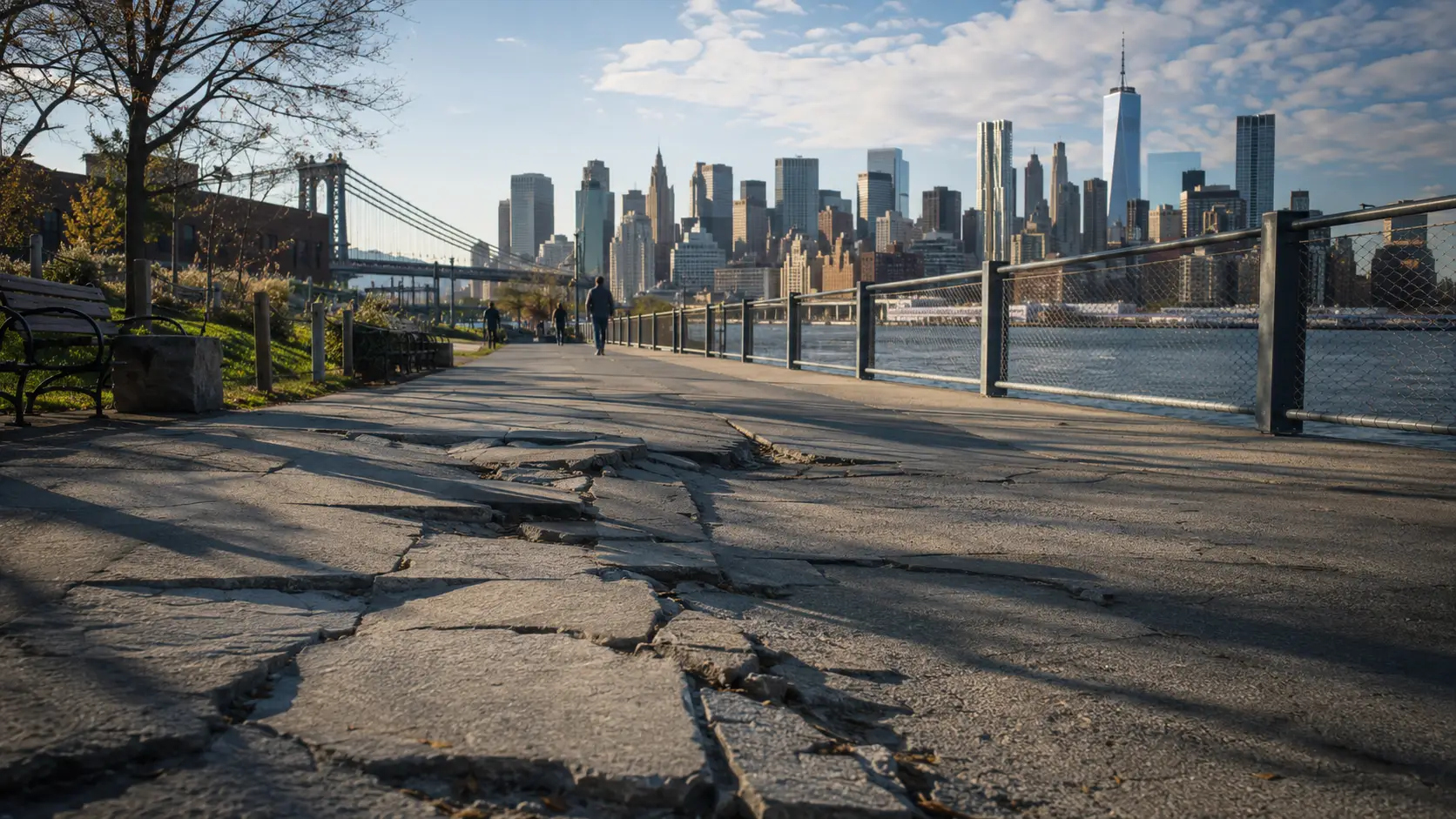
This popular destination draws significant foot traffic, including tourists, cyclists, and families. Those conditions matter legally because high usage makes potential hazards more foreseeable. Important evidence can change or disappear quickly. If you were injured at the DUMBO Waterfront, call Law Office of Irene H. Gabo, P.C. at 800-560-0214 to ask what steps may matter next.
Trip and fall claims at public waterfront areas require careful attention to who controlled the exact spot. A walkway may involve a city agency, a park operator, a nearby private owner, a contractor, or another entity responsible for maintenance. That ownership question often determines the deadline, the evidence needed, and the strategy for proving responsibility.
How Trip and Fall Accidents Happen at DUMBO Waterfront
The area includes park paths, stone surfaces, curb cuts, plaza areas, bridge approaches, ferry-adjacent walkways, and busy pedestrian corridors. Because the area draws tourists, commuters, cyclists, and families, even a small defect can become dangerous when people are focused on crowds, traffic, or waterfront views.
Hazards frequently encountered in this area include raised pavement, cracked concrete, uneven pavers, broken curbs, sunken utility covers, construction plates, loose bricks, tree-root uplift, and poorly lit surface changes. Weather also plays a role. Rain, freeze-thaw cycles, and salt residue can weaken pavement and make older defects harder to see.
Trip and fall cases differ from slip cases because the issue is often a height difference or surface defect, not just a wet floor. New York City standards commonly treat surface height variations above one-half inch as significant in sidewalk defect analysis. A lawyer will usually want photographs with a ruler, coin, shoe, or other measurement reference to show the condition before it is repaired.
These cases are closely related to broader Brooklyn trip and fall accident claims. At DUMBO Waterfront, the local detail matters because the same path may pass near parkland, commercial buildings, public streets, and construction zones. Each area can have a different party in control.
Common Injuries After a DUMBO Waterfront Fall
Falls on hard waterfront surfaces often cause wrist fractures, ankle injuries, knee trauma, hip injuries, shoulder damage, facial injuries, back pain, and head injuries. A person may reach out to break the fall and suffer a fracture or ligament tear. Others land on stone, concrete, or metal edges that can make the impact worse.
The medical timeline is important. Emergency care, imaging, orthopedic follow-up, physical therapy, and specialist referrals help connect the injury to the fall. Delays in treatment can give an insurance company room to argue that the condition came from something else.
Severity also affects case value. A minor bruise may not support the same claim as a fracture, torn ligament, herniated disc, or injury requiring surgery. The legal focus is not only the diagnosis, but how the injury limits walking, working, lifting, sleeping, and daily life.
At a place like DUMBO Waterfront, many injured people are visitors who leave the area quickly after the incident. That can make it harder to return for photos or identify witnesses. Preserving medical records, receipts, ride-share records, photos, and names of people present can help establish where and when the fall happened.
Who Is Legally Responsible for a Trip and Fall at DUMBO Waterfront?
Responsibility depends on control, notice, and proof. A property owner, public agency, park operator, maintenance contractor, construction company, nearby business, or utility contractor may be legally responsible if it created the hazard or failed to address it after having a fair chance to do so.
In New York premises liability cases, an injured person usually must show that a dangerous condition existed, that the responsible party knew or should have known about it, and that the condition caused the fall. Actual notice means the party knew about the specific defect. Constructive notice means the defect was visible and present long enough that reasonable inspections should have found it.
For sidewalks and public walkways, ownership matters. NYC Admin Code §7-210 generally makes adjacent property owners responsible for many sidewalk defects, but there are exceptions. City-owned property, park areas, and certain public spaces may follow different rules, including prior written notice requirements for some municipal defects.
At the DUMBO Waterfront, the exact location of the fall can decide the claim. A defect near a park path may involve different records than a defect outside a storefront or near a street crossing. This is why lawyers examine maps, maintenance boundaries, permits, photographs, inspection records, and complaints. You can also review general guidance on New York sidewalk fall claims to understand how sidewalk responsibility is often evaluated.
What Happens After a DUMBO Waterfront Trip and Fall
The first few days after a fall are often the most important. The surface may be repaired, cones may be moved, weather may change, and the crowd of witnesses may disappear. If the fall happened near a business, park building, ferry area, or managed walkway, surveillance footage may be overwritten within weeks or even sooner.
Reporting the incident creates a record. In a public waterfront area, that report may need to go to park staff, a nearby business, a property manager, NYPD, EMS, or another agency depending on where the fall happened. A missing report does not automatically destroy a claim, but it can make the defense argue that the accident did not happen as described.
Local procedure also affects strategy. If a public entity may be involved, records may need to be requested through FOIL, and a Notice of Claim may be required within 90 days. The attorney must identify the correct entity early because sending notice to the wrong party can create serious problems.
Common mistakes include leaving without taking photos, failing to measure the defect, throwing away the shoes worn during the fall, giving a recorded statement without preparation, or waiting months to seek legal help. These choices can weaken leverage before negotiations even begin.
Special New York Rules That May Apply
Most New York personal injury cases have a three-year statute of limitations. Trip and fall cases at DUMBO Waterfront may be different if the claim involves New York City, a public park entity, a public authority, or another government-controlled property. In those situations, a Notice of Claim may need to be filed within 90 days, and the lawsuit deadline may be one year and 90 days.
Government claims are not handled like ordinary private property cases. The Notice of Claim gives the public entity early notice of the incident and a chance to investigate. Missing that deadline can prevent a lawsuit, even when the injury is serious.
New York also follows pure comparative negligence under CPLR §1411. This means you may still recover compensation even if you were partly at fault. For example, the defense may argue that the defect was open and obvious, that you were looking at the skyline, or that you should have watched your step. If a jury assigns you a percentage of fault, your recovery is reduced by that percentage.
Comparative fault arguments are common in busy tourist areas. A careful case response focuses on lighting, crowd flow, defect size, distractions created by the environment, prior complaints, and whether the responsible party had a reasonable chance to fix or warn about the hazard. Learn more about how comparative negligence works in New York.
What To Do After a Trip and Fall at DUMBO Waterfront
Start by getting medical care. Even if you feel embarrassed or want to leave quickly, pain can worsen after the adrenaline fades. Medical records help document the connection between the fall and your injuries.
Next, photograph the hazard from several angles. Include a close-up, a wider photo showing the surrounding area, and a measurement reference if possible. At DUMBO Waterfront, landmarks like paths, entrances, benches, bridge views, or nearby businesses can help identify the exact location later.
Report the fall to the correct person or entity if you can do so safely. Ask for a copy of any incident report or at least write down the name and title of the person who took the report. If police or EMS responded, keep the report information.
Try to get witness names and phone numbers. Tourists may leave New York the same day, so waiting can make them impossible to locate. Preserve the shoes and clothing you wore, and avoid posting detailed comments about the fall on social media.
For more practical steps, see this guide on what to do after a trip and fall accident. A strong claim often depends on early evidence preservation. Call Law Office of Irene H. Gabo, P.C. at 800-560-0214 to discuss what records, photos, or deadlines may matter in your case.
How Our Lawyers at Law Office of Irene H. Gabo, P.C. Can Help You
Trip and fall cases at DUMBO Waterfront require more than saying the surface was uneven. Our lawyers investigate who controlled the exact area, whether repairs were made, whether prior complaints existed, and whether the dangerous condition was visible long enough to establish notice.
We look for records that show maintenance responsibility. These may include inspection logs, work orders, permits, contractor records, 311 complaints, DOT records, park maintenance materials, incident reports, and photographs from before and after the fall. If a public entity is involved, FOIL requests may be needed to obtain agency records.
We also evaluate the defense story early. In tourist-heavy areas, defendants often blame the injured person for not watching the ground. That argument may be weaker if the defect blended into the walkway, if lighting was poor, if the path was crowded, or if the hazard violated reasonable maintenance standards.
Law Office of Irene H. Gabo, P.C. prepares each case with litigation in mind. That means preserving evidence, identifying the correct defendants, tracking deadlines, organizing medical proof, and negotiating from a position built on documentation rather than assumptions. You can learn more about the firm through our Brooklyn personal injury lawyers page.
Compensation You May Recover
The damages available depend on the nature of your injuries and how they have affected your life. A DUMBO Waterfront trip and fall may support compensation for emergency care, hospital bills, doctor visits, surgery, physical therapy, medication, diagnostic imaging, and future medical treatment.
Lost income may also be recoverable. This includes missed work during recovery and reduced earning capacity if the injury affects your ability to perform your job long term. For workers who stand, walk, lift, drive, or climb stairs, ankle, knee, hip, and back injuries can have a serious financial impact.
Non-economic damages address pain, discomfort, loss of enjoyment of life, sleep disruption, anxiety about walking, and limits on daily activities. These losses are harder to measure, so documentation matters. Medical records, therapy notes, photographs, work records, and statements from family members can help show how the injury changed your routine.
Future damages may be important when an injury causes permanent limitations. A fracture that heals poorly, a torn ligament requiring surgery, or a spinal injury with chronic pain can affect mobility for years. The stronger the medical support, the harder it becomes for the defense to minimize the long-term impact.
Limits and Case Viability
Not every fall leads to a viable legal claim. A case becomes stronger when the defect is measurable, the location is clearly identified, the responsible party can be determined, and the medical records support the injury timeline. Without those pieces, liability can be difficult to prove.
Timing is another major factor. A public property claim may fail if the Notice of Claim deadline is missed. A private property claim may become harder if surveillance footage is gone, witnesses cannot be located, or the defect was repaired before anyone documented it.
Insurance coverage and defendant identity also matter. A contractor may have caused the defect but completed work months earlier. A public agency may control one section while a private owner controls another. Sorting this out early helps avoid suing the wrong party or missing a required procedural step.
A careful review can identify both strengths and problems. That review should include the scene, photographs, medical records, reports, ownership records, prior complaints, and deadline analysis. The goal is to determine whether the evidence, liability, damages, and timing align.
Contact Law Office of Irene H. Gabo, P.C. About a DUMBO Waterfront Trip and Fall
A trip and fall at DUMBO Waterfront can involve public property rules, private maintenance duties, tourist-area crowding, and fast-changing evidence. Speaking with a lawyer early can help protect your claim and clarify which deadlines apply.
To discuss your case, call Law Office of Irene H. Gabo, P.C. at 800-560-0214.
Frequently Asked Questions About DUMBO Waterfront Trip and Fall Claims
Does a DUMBO Waterfront Fall Automatically Mean the Park or City Is Liable?
No. Liability depends on who controlled the exact location and whether that party created the hazard, knew about it, or should have discovered it. Public waterfront areas can involve several entities, so ownership and maintenance records are important.
What Makes a Raised Walkway Defect Legally Important in New York?
Lawyers look at the size, shape, visibility, and location of the defect. In NYC sidewalk cases, a height difference above one-half inch can be significant, but the full context still matters. Photos with measurements are often key evidence.
How Fast Do I Need To Act if the Fall Happened in Brooklyn Bridge Park?
If a public entity may be responsible, a Notice of Claim may be required within 90 days. The lawsuit deadline may also be shortened to one year and 90 days. Because DUMBO Waterfront may involve public property, you should confirm deadlines quickly.
What if I Was Looking at the View or Taking Photos When I Tripped?
The defense may argue comparative negligence, but that does not automatically bar recovery in New York. Your compensation can be reduced by your share of fault. The key is whether the hazard was unsafe and whether the responsible party failed to address it.
What Evidence Should I Save After a Waterfront Trip and Fall?
Save photos, videos, witness names, medical records, incident report information, and the shoes you wore. Also write down the exact location as soon as possible. At tourist-heavy waterfront areas, witnesses and scene conditions can change quickly.
Can I Bring a Claim if I Did Not Report the Fall Right Away?
Possibly. A delayed report can make the case harder, but it does not always prevent a claim. Other evidence, such as medical records, photos, witness statements, and surveillance footage, may still support what happened.