







Motorcycle accidents in Sheepshead Bay produce some of the most severe injuries seen in personal injury practice — and New York’s insurance rules treat motorcyclists differently from other motorists. Riders are excluded from no-fault coverage, which means there is no PIP safety net for medical bills after a crash — but it also means injured motorcyclists can file a lawsuit without meeting the “serious injury” threshold that limits car accident claims. A Sheepshead Bay motorcycle accident lawyer can help you navigate these rules and pursue full compensation.
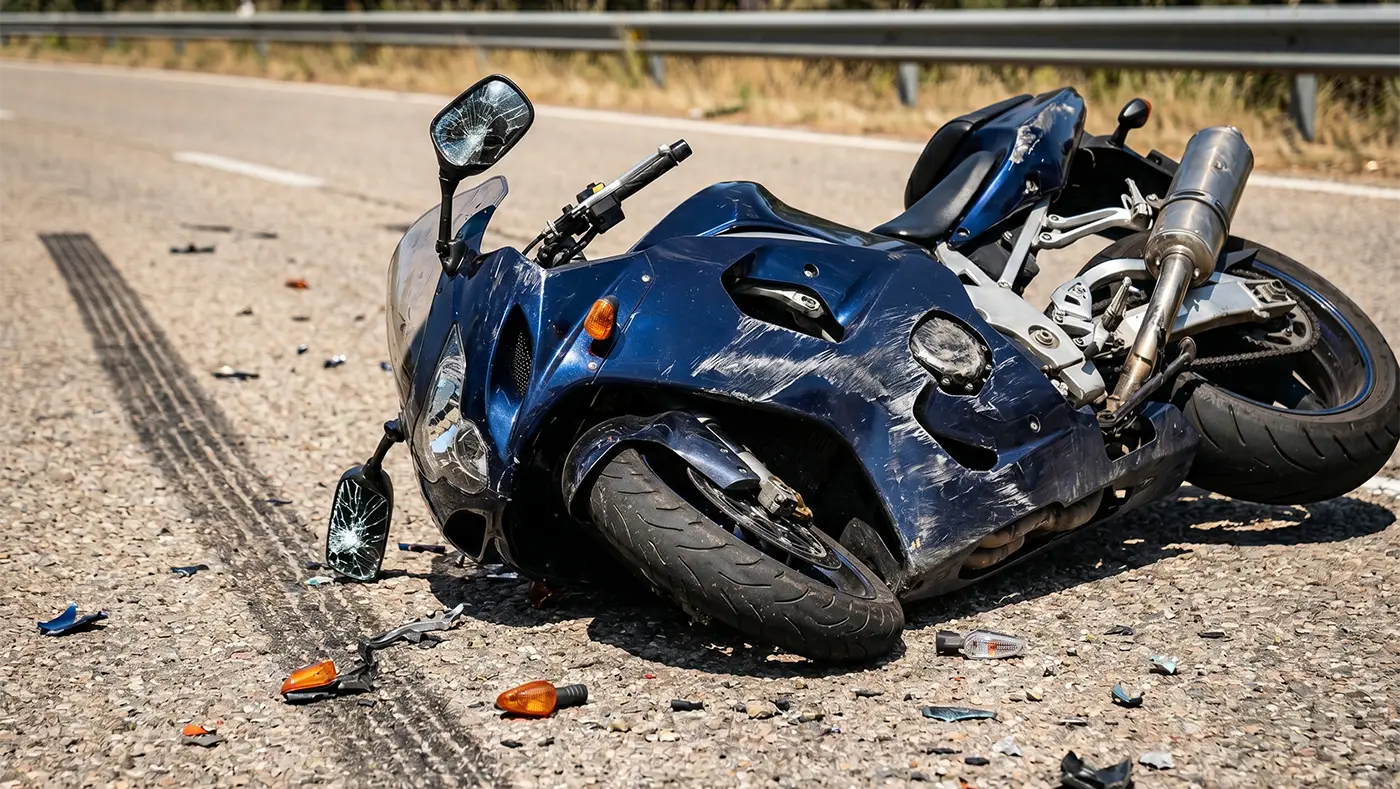
How Motorcycle Accidents Happen in Sheepshead Bay
Sheepshead Bay’s street layout creates specific hazards for motorcyclists. Commercial corridors like Sheepshead Bay Road and Emmons Avenue carry heavy mixed traffic — cars, buses, delivery trucks, and pedestrians — in lanes that leave little room for error. Belt Parkway on-ramps and off-ramps near East 14th Street create high-speed merge zones where motorcycles are particularly vulnerable. Seasonal traffic patterns around the waterfront restaurants and marina add unpredictable vehicle and pedestrian movements, especially on weekends.
Motorcycle Crash Risk in Brooklyn
Brooklyn leads New York City in total motorcycle fatalities, recording 46 deaths over a recent three-year period — more than any other borough. Citywide, motorcyclists account for approximately 14% of all traffic deaths despite representing only 2% of registered vehicles. Driver inattention and failure to yield right-of-way combined cause 38% of motorcycle crashes in New York City, and summer months account for roughly 40% of all motorcycle injury collisions.
Common Crash Scenarios in Sheepshead Bay
Left-turn collisions are among the most frequent and dangerous motorcycle crash patterns. A driver turning left across an oncoming motorcycle’s path — at intersections along Nostrand Avenue, Ocean Avenue, or Avenue U — may misjudge the motorcycle’s speed or simply fail to see it. These crashes often occur at moderate speeds but produce devastating injuries because the motorcycle has no time to brake or maneuver.
Lane-change and merge crashes happen when a driver fails to check blind spots before changing lanes. On multi-lane roads like Ocean Avenue and near Belt Parkway access points, a motorcycle traveling in a driver’s blind spot can be struck with no warning. Rear-end collisions at stop signs, red lights, and in congested traffic along Sheepshead Bay Road are also common — and far more dangerous for a motorcyclist than for a driver protected by a vehicle cabin.
Road surface hazards that a car driver might not notice — potholes, loose gravel, metal plates, oil slicks, uneven pavement at construction zones — can cause a motorcycle to lose traction and crash. When a road defect is caused by a municipality’s failure to maintain the roadway, the entity responsible for maintenance may share liability. Dooring incidents occur when a parked driver opens a car door into the path of an approaching motorcycle, particularly along the commercial stretches near the waterfront.
Common Motorcycle Accident Injuries
Motorcyclists absorb the full force of a collision with no protective vehicle structure between their body and the impact. Even at moderate speeds, the severity of motorcycle injuries is typically far greater than what a car occupant would sustain in a comparable crash.
Traumatic Brain Injury (TBI)
Even with a helmet, a motorcyclist’s head can strike the pavement, another vehicle, or a fixed object with enough force to cause concussions, skull fractures, or severe diffuse axonal injuries that affect cognition, memory, and personality.
Spinal Cord and Back Injuries
Herniated discs, vertebral fractures, and spinal cord damage — including partial or complete paralysis — can result from the violent forces involved in a motorcycle crash. These injuries frequently require surgery and long-term rehabilitation.
Fractures and Orthopedic Injuries
Broken legs, arms, wrists, collarbones, and pelvic fractures are extremely common. Comminuted fractures that shatter bone into multiple fragments often require surgical hardware and extended periods of restricted weight-bearing.
Road Rash and Soft Tissue Injuries
When a rider slides across pavement, severe abrasion injuries can penetrate through skin into muscle and bone. Serious road rash often requires skin grafting, produces permanent scarring, and carries a high risk of infection.
Internal Organ Injuries and Amputations
Blunt force trauma to the chest and abdomen can damage the liver, spleen, kidneys, or lungs. In the most severe collisions, crush injuries to extremities can result in traumatic amputation or surgical amputation after failed limb salvage.
The severity of motorcycle injuries directly affects case value and legal strategy. Early, thorough medical documentation — including emergency room records, surgical reports, imaging studies, and functional assessments — is essential to establishing the full extent of harm. For a broader overview of how we handle motor vehicle injury cases, see our Brooklyn motor vehicle accident lawyers page.
Insurance Rules for Motorcyclists in New York
New York’s insurance framework treats motorcyclists fundamentally differently from car occupants. Understanding these rules is critical because they determine where your medical bills get paid, what you need to prove, and what types of damages you can pursue.
Motorcyclists Are Excluded From No-Fault (PIP) Coverage
Under Insurance Law § 5102(f), motorcycles are not classified as “motor vehicles” for purposes of New York’s No-Fault Law. This means motorcycle operators and passengers are not eligible for Personal Injury Protection benefits — no automatic coverage for medical bills, lost wages, or rehabilitation expenses through PIP. This creates an immediate financial gap after a crash.
No “Serious Injury” Threshold Required to Sue
The flip side of the no-fault exclusion is that motorcyclists are exempt from the serious injury threshold under Insurance Law § 5102(d). Car accident victims must prove a “serious injury” — such as a fracture, permanent limitation, or significant disfigurement — before filing a lawsuit. Motorcyclists can sue the at-fault driver for any injury, including pain and suffering, regardless of severity.
Key Fact: Because motorcyclists cannot access no-fault PIP benefits, medical bills after a crash must typically be covered through personal health insurance, the at-fault driver’s liability policy, or out-of-pocket payment. Uninsured/underinsured motorist (UM/UIM) coverage on your own motorcycle policy — if you carry it — can also be a critical source of recovery when the at-fault driver has minimal or no insurance.
Who Is Legally Responsible for a Sheepshead Bay Motorcycle Accident
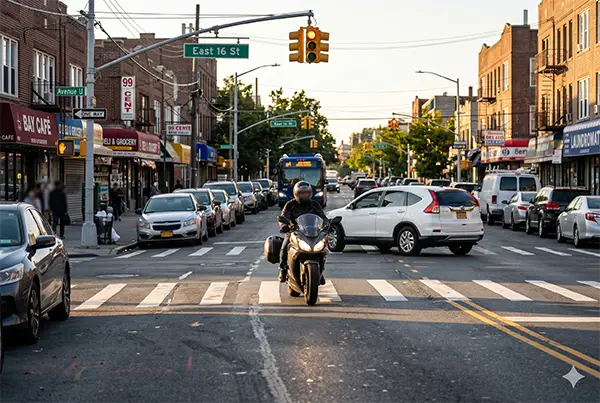
Liability in a motorcycle accident case turns on who acted negligently and whether that negligence caused the crash. In Sheepshead Bay, the responsible party is most commonly another driver — but liability can extend to other parties depending on the circumstances.
A negligent motorist who failed to yield, turned left across the motorcycle’s path, changed lanes without checking blind spots, or was distracted by a phone is the most common defendant. A commercial vehicle operator or employer may be liable when a delivery truck, bus, or ride-share vehicle causes the crash during the course of employment.
A municipality can share liability when a road defect — a pothole, unrepaired pavement, missing signage, or improperly placed construction plate — contributed to the crash. These claims trigger the 90-day Notice of Claim requirement under General Municipal Law § 50-e. In rare cases, a motorcycle or parts manufacturer may be liable if a defective component — brakes, tires, throttle, or frame — caused or contributed to the crash.
Defense teams in motorcycle cases frequently argue that the rider was speeding, weaving through traffic, or operating recklessly. New York’s pure comparative negligence rule means the rider can still recover damages even if partially at fault, but the award is reduced by the rider’s percentage of responsibility. Strong evidence about what actually happened — witness statements, surveillance footage, crash scene photos, and expert accident reconstruction — is critical to countering these arguments. For more on comparative fault, see our explanation of what comparative negligence means in New York.
Filing Deadlines
Road Defect Claims Require Fast Action
If your motorcycle crash was caused by a pothole, uneven pavement, a missing manhole cover, or another road defect on a city-maintained street, you must file a Notice of Claim within 90 days and file suit within one year and 90 days. In Sheepshead Bay, determining whether a road defect is maintained by the NYC Department of Transportation, the NYC Department of Environmental Protection, or another agency is a critical first step — and the 90-day clock starts running from the date of the crash, not the date you identify the responsible entity.
What to Do After a Motorcycle Accident in Sheepshead Bay
The steps taken immediately after a motorcycle accident can determine whether the case succeeds or fails. Because motorcyclists lack no-fault coverage, the burden of proving the other driver’s fault falls entirely on the injured rider — which makes evidence preservation especially critical.
- Call 911 and get medical attention immediately. Motorcycle injuries are frequently more serious than they feel at the scene due to adrenaline. An ambulance and police response also creates official documentation of the crash.
- Do not move the motorcycle unless it creates a safety hazard. The position of the vehicles and debris can help reconstruct how the crash occurred.
- Photograph everything — the damage to both vehicles, the road surface, skid marks, traffic signals, nearby signage, and your injuries. Include wide shots showing the intersection or road layout.
- Exchange information with the other driver, including insurance details, license plate number, and driver’s license information. Get names and phone numbers of witnesses.
- Do not admit fault or apologize at the scene. Statements made after a crash can be used against you later.
- Notify your own insurance carrier of the accident promptly. If you carry uninsured/underinsured motorist coverage, it may be a critical source of recovery.
- Request preservation of any surveillance footage from nearby businesses, traffic cameras, or residential doorbell cameras before it is overwritten.
- Contact an attorney before giving a recorded statement to the other driver’s insurance company. Insurers in motorcycle cases frequently look for ways to assign fault to the rider.
Injured in a Motorcycle Crash in Sheepshead Bay?
If you were hurt in a motorcycle accident caused by another driver’s negligence, you have the right to sue for full compensation — including pain and suffering — without meeting the serious injury threshold. Contact us for a free case evaluation.
Get a Free ConsultationCompensation You May Recover in a Motorcycle Accident Lawsuit
Because motorcyclists are exempt from the serious injury threshold, the full range of damages is available from the first dollar of loss. The value of a motorcycle injury claim depends on the severity of injuries, the quality of medical documentation, and the strength of the liability evidence.
Medical expenses include emergency treatment, hospitalization, surgery, imaging, physical therapy, prescription medications, and future care. Because motorcyclists cannot access no-fault PIP benefits, recovering these costs through a liability claim or lawsuit is often the only path to financial recovery.
Lost income covers wages missed during recovery and reduced future earning capacity if the injury prevents return to the same type of work. Pain and suffering addresses the daily impact of chronic pain, scarring, loss of mobility, anxiety about riding or being in traffic, and the overall diminishment in quality of life.
Property damage to the motorcycle itself, riding gear, and personal belongings damaged in the crash is also recoverable. When the at-fault driver’s insurance is insufficient, uninsured/underinsured motorist coverage on your own policy can provide additional recovery. For a broader overview of how injury damages are evaluated, see our guide to what non-economic damages are.
How Our Lawyers at the Law Office of Irene H. Gabo, P.C. Can Help
Motorcycle accident cases require aggressive investigation and careful handling of the anti-rider bias that insurance companies and defense attorneys frequently exploit. Our role is to build a case that tells the true story of what happened — supported by evidence, not assumptions about motorcyclists.
Crash Investigation and Evidence Collection
We secure the police report, photograph the crash scene, obtain surveillance footage from nearby businesses and traffic cameras, and preserve the motorcycle and damaged gear as physical evidence. When the crash involves complex dynamics, we work with accident reconstruction experts.
Identifying All Sources of Recovery
We investigate the at-fault driver’s liability coverage, your own UM/UIM policy, any commercial insurance if a work vehicle was involved, and municipal liability if a road defect contributed to the crash. Identifying every available coverage layer maximizes your potential recovery.
Countering Anti-Rider Bias
Insurance adjusters routinely argue that the motorcyclist was speeding, weaving, or riding recklessly — even without evidence. We build the factual record to counter these assumptions using witness testimony, camera footage, speed data, and expert analysis.
Negotiation and Litigation
We document the full cost of the injury — medical, financial, and personal — and pursue maximum recovery through negotiation with insurers. When a fair settlement cannot be reached, we prepare for trial.
Contact Us Today to Discuss Your Rights and Whether You are Entitled to Compensation
To discuss your motorcycle accident case, visit our contact page or call (800) 560-0214 for a free consultation.
Frequently Asked Questions
Generally, no. Under Insurance Law § 5102(f), motorcycles are excluded from the definition of “motor vehicle” for purposes of New York’s No-Fault Law. This means motorcycle operators and passengers are not eligible for Personal Injury Protection (PIP) benefits. Medical bills after a motorcycle crash must typically be covered through personal health insurance, the at-fault driver’s liability policy, or your own UM/UIM coverage.
No. Motorcyclists are exempt from the serious injury threshold under Insurance Law § 5102(d). Unlike car accident victims, who must prove a fracture, permanent limitation, or significant impairment before suing, motorcyclists can file a lawsuit for any injury — including pain and suffering — as long as another party was at fault for the crash.
The statute of limitations for most motorcycle accident lawsuits is three years from the date of the crash under CPLR § 214. However, if a road defect or municipal entity was involved, a Notice of Claim must be filed within 90 days under General Municipal Law § 50-e, and the lawsuit deadline shortens to one year and 90 days.
Yes. New York follows a pure comparative negligence rule, meaning you can recover damages even if you were partially at fault. Your compensation is reduced by your percentage of responsibility — for example, if you are found 20% at fault, your recovery is reduced by 20%. Defense teams in motorcycle cases frequently argue rider fault, which is why strong evidence about what actually happened is essential.
If the at-fault driver is uninsured or underinsured, your own motorcycle insurance policy may provide coverage through uninsured/underinsured motorist (UM/UIM) provisions — if you carry that coverage. UM/UIM claims are filed against your own insurer and can be a critical source of recovery when the other driver’s policy is inadequate to cover your injuries. If neither driver has coverage, you may be eligible for benefits through the Motor Vehicle Accident Indemnification Corporation (MVAIC).
Frequently, yes. Insurance adjusters and defense attorneys often exploit anti-rider bias — arguing that motorcyclists are inherently reckless or that the rider must have been speeding, even without evidence. This is why early evidence collection — including witness statements, surveillance footage, police reports, and accident reconstruction analysis — is so important in motorcycle cases. The factual record should speak for itself, not the assumptions.